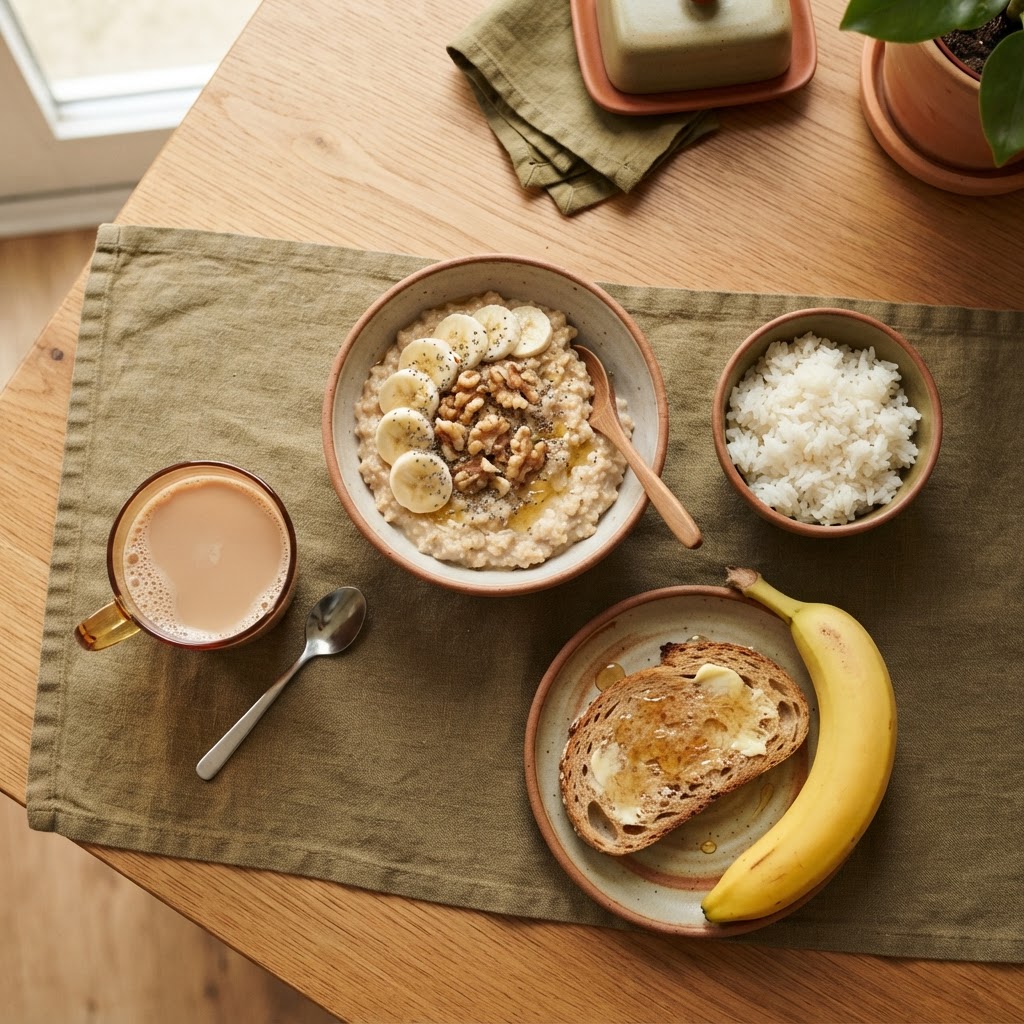
What Should You Actually Eat as a Runner?
By Will, Founder
Ever hit the dreaded "wall" during a long run? Your legs suddenly feel like cement. Your brain begs you to stop.
Maybe you wonder if you are eating enough for your current training volume. Or maybe you just want to know the secret to unlocking top performance.
It is a common problem for everyday runners. But it does not have to happen to you.
TL;DR: Your body runs on carbs, not just water and grit. To stop crashing, you need to eat more carbs on hard days and fewer on easy days. Mix your sugars (like glucose and fructose) to save your stomach from cramps, and treat salt like your best friend. Below, we break down exactly how 14 elite athletes eat in the real world—and give you simple meal plans to fuel your next run.
(Note: The science and athlete meals in this guide have been fully fact-checked against current sports nutrition data.)
🧱 The 4 Golden Rules of Runner Nutrition
1. Carbs Are Your Smartphone Battery
Your body only stores enough carbs to last about 90 to 120 minutes of hard running. If you run long without eating more carbs, your internal battery hits 0%. Your brain literally forces your body to slow down to survive.
2. The Two-Lane Gut Highway
Why do runners get stomach cramps? Your stomach can only handle so much sugar at once. If you eat just one type of sugar (like pure glucose), it creates a traffic jam. If you mix two types (like glucose and fructose), you open a second lane. This lets you absorb massive amounts of energy with zero cramps.
3. Fuel the Work (Change Daily!)
Do not eat the exact same meals every day! Match your food to your training. Eat more carbs on hard workout days. Eat fewer carbs on easy recovery days. Treat your food like a budget for the day's work.
4. Salt is a Sugar Magnet
Hydration is not just plain water. When you sweat, you lose sodium. But salt does more than stop cramps. Sodium acts like a magnet in your gut. It actively pulls sugar into your blood much faster, giving you instant energy when you need it most.
🔬 Rocket Fuel vs. Diesel: How Your Engine Works
Before you worry about what to eat, you need to know how your body burns fuel. You have two main tanks:
- 🥩 Rocket Fuel (Carbs): Your body stores carbs in your muscles and liver. This fuel burns super fast to power your hardest runs and fast paces. But the tank is small.
- 🧈 Diesel Tank (Body Fat): You have tens of thousands of calories stored as body fat. But fat burns very slowly. It is great for walking or jogging, but it cannot power a fast race pace.
Because you burn different fuels for different speeds, your everyday diet needs to adapt:
- 🟢 Easy Days: Balanced meals. Lower carbs and high protein to help muscles rebuild.
- 🟡 Hard Workout Days: A carb-heavy snack before you run. High carbs all day to refuel your muscles.
- 🔴 Long Run Days: A huge carb-heavy dinner the night before. High carbs all day long to keep the battery charged.
🏃♂️ The 14 Athlete Profiles: Insider Secrets
Let's look at the real-world, everyday diets of top athletes. What counter-intuitive secrets can everyday runners learn from them?
1. Eliud Kipchoge (The Marathon Legend)
He eats a simple Kenyan diet of Ugali (cornmeal) and greens. Why it works: Before morning runs, he drinks sweet, milky tea. After fasting all night, the liquid sugar hits his empty liver instantly, turning the engine on for a hard effort without needing solid food.
2. Hugo Fry (Elite Marathoner)
Exactly 90 minutes before a hard track workout, Hugo eats a pouch of microwave rice mixed with Nutella. Why it works: White rice and simple syrup digest instantly. It gives him a massive energy spike that is completely gone from his stomach by the time he starts running.
3. Jake Dearden (HYROX World Record Holder)
Jake burns over 5,000 calories a day. Before workouts, he eats two large bowls of Coco Pops cereal with oat milk. Why it works: Healthy, high-fiber foods take too long to digest. Kids' cereal is highly processed, meaning the carbs turn into rocket fuel in his bloodstream almost immediately.
4. Eric Floberg (2:29 Marathoner)
Eric keeps his mornings exactly the same. He eats overnight oats soaked in chia seeds, topped with whey protein. Why it works: It provides a slow, steady drip of energy. The protein protects his muscle tissue from breaking down during long, pounding miles.
5. Josh Kerr (1500m World Champion)
Josh eats strict gluten-free foods and adds raw spinach to his lunch and dinner. Why it works: Gluten-free keeps his joint inflammation low. More importantly, spinach is packed with natural nitrates, which literally opens his blood vessels and helps his muscles use oxygen better.
6. Keely Hodgkinson (800m Olympic Champion)
Keely blends her oatmeal and fruit into smoothies, and eats red meat twice a week. Why it works: Blending oats pre-digests them, so they leave her stomach faster. The red meat protects her iron levels, a critical mineral that female runners often lose through heavy training.
7. Tom Evans (Ultra Marathon Champion)
Two days before a huge race, Tom completely stops eating vegetables, beans, and seeds, switching to plain white rice and chicken. Why it works: Fiber stays in your gut for two days. Quitting fiber drops pounds of "dead weight" from his intestines and stops mid-race bathroom emergencies.
8. Nick Bare (Hybrid Pioneer)
Nick lifts heavy weights and runs high mileage. He eats massive amounts of white jasmine rice, ground beef, and sweet potatoes. Why it works: Running burns muscle if you do not eat enough. Huge portions of dense carbs stop his body from eating its own muscle for fuel.
9. Lucy Davis (Hybrid & Triathlete)
Instead of just sipping water, Lucy drinks a heavy dose of salt (1,000mg) before hot workouts. Why it works: Loading salt expands your blood volume. Thicker, higher-volume blood keeps your heart rate lower and delays exhaustion when you are sweating heavily.
10. Hans Troyer (100-Mile Ultra Champion)
Hans buys fresh white baguettes from the supermarket to eat as his main carb source. Why it works: Bread is cheap, easy to carry, and packed with simple carbs. It proves you do not need expensive, fancy powders to fuel massive 100-mile weeks.
11. Sally McRae (200-Mile Ultra Champion)
Her everyday favorites are whole boiled potatoes with salt and avocado wraps. Why it works: For multi-day efforts, your stomach gets "flavor fatigue" from sweet sugars. Salty, savory whole foods trick your brain into wanting to eat and provide slow-burning fats.
12. Laura Ashleigh (Hyrox & Flight Attendant)
On hard training days, she eats oats before her workout and prawn pasta after. On rest days, she focuses purely on protein. Why it works: She perfectly budgets her food. Carbs surround her workouts for energy, but on rest days, she drops the carbs to let protein rebuild her body.
13. Max Jolliffe (Badwater 135 Champion)
Max has to constantly eat huge plates of pasta and rice just to keep his body from crashing during 140-mile training weeks. Why it works: He eats so many carbs daily that he never wakes up with an energy "sleep debt." His rocket fuel tanks are always 100% full.
14. The Everyday Runner ("The Baseline")
The average runner often wakes up and runs on an empty stomach. They eat the exact same meals on a rest day as they do on a 10-mile run day. Why it fails: Running empty limits your speed. By simply eating a piece of toast before a run, they could instantly run faster and feel amazing.
📊 Dietary Scorecard
How do these eating styles compare? We ranked them on Effectiveness (Function), Daily Ease (Practicality), Taste, and Novelty.
| Athlete Profile | Function /10 | Practicality /10 | Taste /10 | Novelty /10 | TOTAL /40 | Highlight / Drawback |
|---|---|---|---|---|---|---|
| 🥇 Josh Kerr | 9.7 | 9.5 | 8.5 | 8.5 | 36.2 | Spinach nitrates are a clever, natural oxygen booster. |
| 🥈 Tom Evans | 9.8 | 9.0 | 9.0 | 7.5 | 35.3 | Quitting fiber before a race is a game-changer for a happy gut. |
| 🥉 Nick Bare | 8.5 | 9.9 | 8.0 | 7.0 | 33.4 | Rice and beef is the easiest way to get massive calories. |
| 4. Hugo Fry | 9.6 | 8.2 | 7.0 | 8.0 | 32.8 | Rice and Nutella is weird, but perfectly pre-digested energy. |
| 5. Jake Dearden | 8.8 | 9.8 | 7.5 | 6.5 | 32.6 | Using kids' cereal as a tactical advantage is brilliant. |
| 6. Keely Hodgkinson | 9.2 | 8.8 | 8.5 | 6.0 | 32.5 | Blended oats digest fast; red meat protects female iron levels. |
| 7. Eliud Kipchoge | 9.5 | 8.0 | 5.5 | 9.0 | 32.0 | Sweet tea wakes up the liver perfectly, but the diet lacks variety. |
| 8. Laura Ashleigh | 9.0 | 8.5 | 9.0 | 5.5 | 32.0 | Perfect food budgeting: carbs for hard days, protein for rest days. |
| 9. Hans Troyer | 7.5 | 6.5 | 8.5 | 9.5 | 32.0 | Baguettes are a brilliantly cheap and effective fuel source. |
| 10. Sally McRae | 8.5 | 8.5 | 8.0 | 6.5 | 31.5 | Savory food fixes flavor fatigue, but can feel heavy on short runs. |
| 11. Eric Floberg | 9.2 | 8.5 | 7.5 | 6.0 | 31.2 | Overnight oats are the ultimate easy, reliable morning fuel. |
| 12. Lucy Davis | 8.0 | 9.2 | 8.5 | 5.0 | 30.7 | Smart focus on pre-loading salt to keep the heart rate down. |
| 13. Max Jolliffe | 9.0 | 8.0 | 6.5 | 7.0 | 30.5 | Keeps the tanks totally full, but eating all those carbs is a chore. |
| 14. Everyday Runner | 5.5 | 6.0 | 7.0 | 2.0 | 20.5 | Runs on an empty tank. Huge room for easy improvements! |
🍽️ Simple Daily Meal Plans
Here are two easy-to-follow meal plans. One is for a hard workout day, and the other is for an easy rest day.
🔴 The Hard Workout Day
Goal: High Carbs for Rocket Fuel, High Protein for Repair
- Breakfast: Oatmeal cooked in milk, a sliced banana, and maple syrup.
- Pre-Workout Snack: A pouch of microwave rice with Nutella, OR a bowl of cereal.
- Post-Workout: A protein shake with a banana, or eggs with crispy potatoes.
- Lunch: White rice, grilled chicken, and green beans.
- Dinner: Pasta with lean ground turkey and steamed broccoli.
- Evening Snack: Greek yogurt topped with granola and honey.
🟢 The Easy Rest Day
Goal: Lower Carbs (Saving the budget), High Protein
- Breakfast: Oatmeal, honey, cinnamon, and black coffee.
- Pre-Workout Snack: A medium banana or two dates.
- Post-Workout: A glass of chocolate milk or a protein bar.
- Lunch: A whole wheat wrap with turkey, spinach, and tomatoes.
- Dinner: Baked chicken breast, a small side of rice, and mixed veggies.
- Evening Snack: A few squares of dark chocolate or an apple with almond butter.
🏁 Your 3-Step Action Plan
- Stop Eating the Same Thing: Treat your carbs like a budget. Eat more of them on the days you run hard. Eat fewer of them on days you rest.
- Find Your Pre-Run Carb: Find a simple carb (like white toast, rice, or cereal) that does not hurt your stomach. Eat it 60 to 90 minutes before a hard run.
- Eat Protein Fast: Eat a good source of protein within 45 minutes of finishing your run. Do not wait for hours. This stops muscle breakdown and speeds up recovery.
Start matching your meals to your workouts today. You will instantly feel stronger, and watch your running times drop!
Stop guessing. Start knowing.